
Maricopa community college football

A PROMISE NEEDS A PLAN.

Restoring football deserves a clear account of its costs and educational benefits.

Our position: financial accountability and educational opportunity.

What they propose together

Winder, Crow and Caracciolo promise to bring football back. Their numbers don’t add up to a viable budget.

All three jointly promise to bring back junior-college football. The figures they and their site point to don’t match: on FOX 10, Crow said “let’s say it’s a million and a half” for the program and cited about $1.1 million in tuition from its players; the article on their own site cites the district’s 2018 estimates of about $770,000 a year for four programs and more than $20 million that could eventually be needed for capital improvements; and the unsigned plan their football page links relies on a new student fee that it says must rise with inflation: “Indexing is essential: without it, every version eventually falls short.” In a 2019 Northeast Valley News report, a district spokesman said the primary factor in ending football was “the financial viability of sustaining these programs long term.”

Winder, Crow and Caracciolo promise to bring football back. Their numbers don’t add up to a viable budget.

All three jointly promise to bring back junior-college football. The figures they and their site point to don’t match: on FOX 10, Crow said “let’s say it’s a million and a half” for the program and cited about $1.1 million in tuition from its players; the article on their own site cites the district’s 2018 estimates of about $770,000 a year for four programs and more than $20 million that could eventually be needed for capital improvements; and the unsigned plan their football page links relies on a new student fee that it says must rise with inflation: “Indexing is essential: without it, every version eventually falls short.” In a 2019 Northeast Valley News report, a district spokesman said the primary factor in ending football was “the financial viability of sustaining these programs long term.”

Three numbers, no budget. Nothing they have published shows football would be financially viable, and Winder wrote that college should not be paid for with tax money, except for students with special needs. Students could be left to pay.

Context

Supporters’ experiences deserve consideration. The article on the slate’s site says Crow proposes a “phased public-private model” with fundraising and sponsorships, and that Caracciolo proposes sponsorships, private fundraising and partnerships; as described, neither includes a dollar figure. Crow’s figure was an annual cost; the $20 million was a one-time capital estimate that the district never itemized and that was disputed at the time. In 2018 the district also cited flat enrollment and the end of state support.

Sources: Change4Maricopa: shared campaign platform Change4Maricopa: football campaign page Change4Maricopa: article by Linda Brickman FOX 10 Talks with John Crow and Ryan Caracciolo, September 15, 2026 (FOX 10 Phoenix) Football “Strategic Framework” linked from Change4Maricopa (unsigned) (Unsigned document linked from Change4Maricopa) ABC15: Maricopa Community Colleges eliminating football programs after 2018 (ABC15 Arizona) Northeast Valley News: the lawsuit over the end of community college football Screenshot Screenshot of the football page of the Change4Maricopa website under the heading “YOUR CANDIDATES THAT WILL BRING JUCO FOOTBALL BACK”, listing Ryan Caracciolo, District 4; John David Crow, Member at Large; and Susan Winder, District 3.

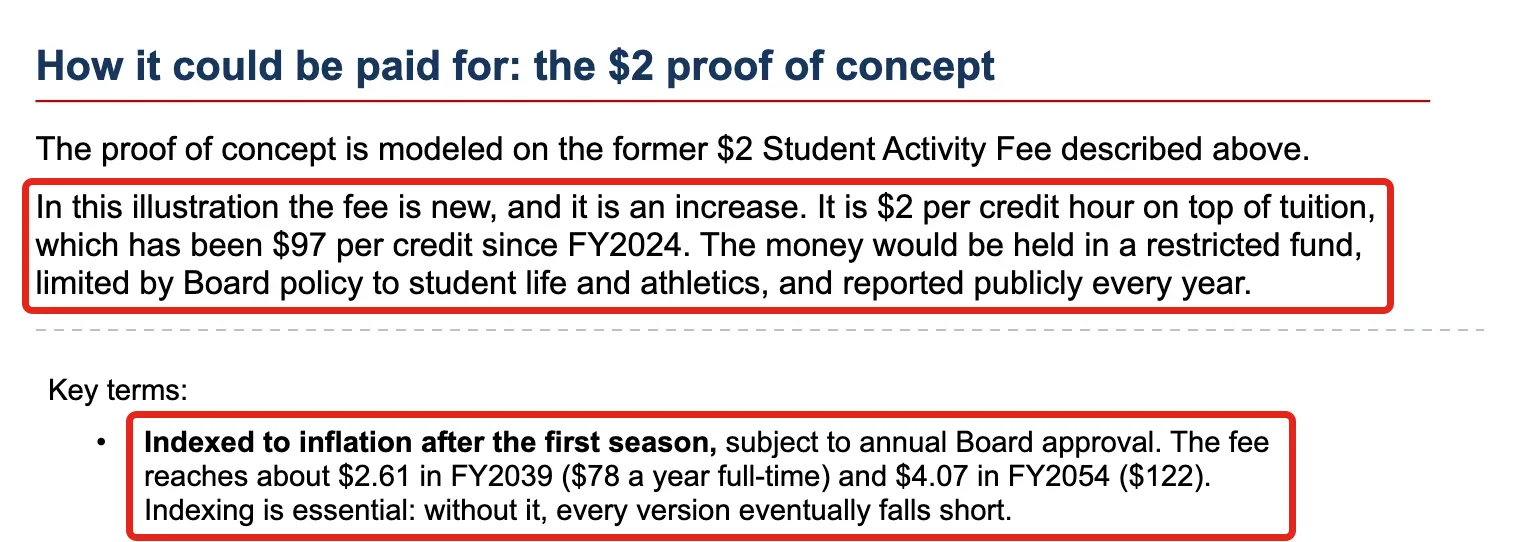
Winder, Crow and Caracciolo’s site links a football plan whose new $2-per-credit fee must keep rising with inflation, or it eventually falls short.

The slate’s joint campaign site now links an unsigned football plan and financial model. In its illustration of how to pay for football, the plan adds a new Student Life & Athletics Fee of $2 per credit hour on top of tuition and says it must rise with inflation, to about $4.07 by 2054: “Indexing is essential: without it, every version eventually falls short.” Up to 60% of the fee goes to football after launch. As one way to lower that fee, it lists a property tax increase of $1 million a year dedicated to the fund.

“In this illustration the fee is new, and it is an increase. It is $2 per credit hour on top of tuition, which has been $97 per credit since FY2024. … Indexing is essential: without it, every version eventually falls short.”

Unsigned football plan linked from Change4Maricopa, captured October 1 and 2, 2026

Football doesn’t pay for itself. The plan their website links would add a new fee to every credit, raising tuition, and says the fee should rise with inflation, subject to annual Board approval. And Winder wrote in 2024 that college should not be paid for with tax money, except for students with special needs.

Context

The plan and model name no author or date; as of October 1, 2026, we found no candidate calling them their own. Their joint site links them under “YOUR CANDIDATES THAT WILL BRING JUCO FOOTBALL BACK.” The plan calls itself “an illustration for public discussion, not a final plan,” and the model says its projections “are not forecasts, budgets or financing commitments.” The plan says “any new fee or tax should be a last resort,” models the fee on a $2 student activity fee that, it says, the district combined with tuition in 2014, and gives the rest of the fee to existing sports and student life at all 10 colleges. The property tax increase is one of several optional ways to lower the fee, not part of its base case: the plan lists “a property tax increase of $1 million a year dedicated to the fund, roughly 16 cents a year per $100,000 of home value” as “Board-discretionary (within the Board’s authority, not yet adopted),” and its own options table calls it “a tax increase: a last resort requiring a Truth in Taxation hearing.” The $4.07 figure is in future dollars. The plan sets a $5.0 million planning allowance for facility improvements; in 2018 the district said the programs could require more than $20 million in capital improvements and associated expenses. The model builds about $26 million of capital capacity through 2054. Linda Brickman’s September 24 article on the same site described Crow’s proposal as a “phased public-private model” with fundraising and sponsorships, and Caracciolo’s as sponsorships, private fundraising and partnerships; it did not propose a student fee. The quote above joins two passages, marked with …: the fee paragraph, and the last sentence of the plan’s indexing term, which begins “Indexed to inflation after the first season, subject to annual Board approval.”

Sources: Football “Strategic Framework” linked from Change4Maricopa (unsigned) (Unsigned document linked from Change4Maricopa) Football “Financial Model” linked from Change4Maricopa (unsigned) (Unsigned spreadsheet linked from Change4Maricopa) Change4Maricopa: football campaign page Screenshot Two passages from the football plan linked from the Change4Maricopa website, cropped and joined by this site: “In this illustration the fee is new, and it is an increase. It is $2 per credit hour on top of tuition, which has been $97 per credit since FY2024. … Indexing is essential: without it, every version eventually falls short.” The second passage, under “Key terms,” reads in full: “Indexed to inflation after the first season, subject to annual Board approval. The fee reaches about $2.61 in FY2039 ($78 a year full-time) and $4.07 in FY2054 ($122). Indexing is essential: without it, every version eventually falls short.”

Other statements about the proposal

Crow’s football math leaves out a $20 million-plus district estimate. On FOX 10 Crow guessed the program cost “a million and a half,” but the district’s 2018 estimate, cited on his own Change4Maricopa slate’s website, says facilities could eventually need more than $20 million.

On FOX 10 Talks, asked what the football program cost, Crow said, “Let’s say it’s a million and a half,” and said players’ tuition brought in about $1.1 million, arguing the district cut enrollment and revenue when it cut the program.

“Let's say it's a million and a half. … But you have a million, 1.1 million thereabouts in tuition from the athletes that are playing there. None of them are on full rides. So you cut enrollment. You cut revenue when you cut the program.”

John David Crow, September 15, 2026

Crow’s “million and a half” leaves out the one-time capital costs: the district’s 2018 estimate, cited on his own Change4Maricopa slate’s website, that the programs could eventually need more than $20 million in capital improvements.

Context

The host had said Crow told him during a break that the better question about football was why it was not saved. The district’s 2018 figures, cited in the article on the Change4Maricopa slate’s own site, were about $770,000 a year for four programs, plus more than $20 million that could eventually be needed for facilities. Quote shortened and repeated words dropped; the cut, a short interjection that may be the host’s, is marked with ….

Sources: FOX 10 Talks with John Crow and Ryan Caracciolo, September 15, 2026 (FOX 10 Phoenix) Change4Maricopa on Instagram: “Featured on FOX 10 Xtra!” (Instagram, @change4maricopa) Change4Maricopa: article by Linda Brickman Screenshot Frame from FOX 10 Talks. From left: Ryan Caracciolo, John Crow and two FOX 10 hosts at a round desk. Crow says: “Let's say it's a million and a half. … But you have a million, 1.1 million thereabouts in tuition from the athletes that are playing there. None of them are on full rides. So you cut enrollment. You cut revenue when you cut the program.”

Today’s financial context

The budget has commitments.

These records describe district conditions. They do not attribute those conditions to the candidates or calculate the cost of restoring football.

About three-quarters of the district’s General Fund ongoing resources come from local taxes.

74%of the General Fund’s ongoing resources come from local taxes

The adopted FY2026-27 budget lists $637,500,308 in property taxes and Salt River Project payments in lieu of taxes, out of $857,448,603 in General Fund ongoing resources. That is 74.35 percent, and about three times the $208,327,973 in General Fund tuition and fees.

Cut that support without replacing it, and the bill lands on tuition or classes. The budget shortfall will negatively impact our education somewhere.

Context

This is the main operating fund, not the entire district budget, and these are budgeted amounts. Tuition is unchanged for 2026-27, for a fourth straight year.

Sources: Maricopa Community Colleges: adopted FY2026-27 budget (Maricopa County Community College District) District keeps tuition unchanged for a fourth year (Maricopa Community Colleges)

The district’s available resources and annual spending are different

The adopted FY2026-27 budget lists about $1.815 billion in total resources, including fund balances, and about $1.392 billion in budgeted expenditures across all funds.

Context

A total resource figure is not money freely available for a new program. A football proposal needs its own cost estimates and identified funding sources.

Source: Maricopa Community Colleges: adopted FY2026-27 budget (Maricopa County Community College District)

The district reports no state operating aid for a twelfth year

$0in state operating aid, 12 years running

On June 23, 2026, Maricopa Community Colleges announced that it would receive no state operating aid for the twelfth consecutive year.

Context

This concerns a specific aid category. The adopted budget includes separate state STEM funding. These existing conditions are not attributed to the three candidates.

Sources: District reports a twelfth year without state operating aid (Maricopa Community Colleges) Maricopa Community Colleges: adopted FY2026-27 budget (Maricopa County Community College District)

Questions for evaluating the proposal

Before committing public funds.

These are our standards for evaluating a complete proposal. They are not claims about decisions already made.

  1. What would the full cost be?

    A budget should distinguish startup expenses from annual operations and include staff, facilities, travel, equipment, insurance and student support.

  2. Where would the money come from?

    The plan should identify funding sources and explain how existing academic programs would be protected. Total district resources are not the same as money available for a new program.

  3. Where and against whom would teams play?

    Facilities need a current assessment. Schedules and agreements with other colleges should be confirmed before calculating travel expenses.

  4. How would outcomes be measured?

    Goals should address student health, persistence, transfer and graduation. Individual experiences matter, but evaluating a program requires clearly defined data.

Our editorial standard

Evaluate the full commitment.

Before supporting a restoration plan, we want to see current cost estimates and identified funding sources. The proposed facilities and schedule should be specific enough for voters to assess the assumptions.

Our evaluation should consider academic outcomes alongside financial commitments.

Read the sources and our methodology